

Q: In your view, what makes a successful evaluation?
A successful evaluation in my opinion has the following ingredients:
- Relationship-Building
The evaluator(s), commissioners, and direct beneficiaries of the evaluation findings should have touchpoints that are human-centric and allow space for codevelopment.
- Applying Culturally Responsive and Equitable Evaluation (CREE) Principles
I codeveloped a framework that embodies the principles of CREE, which are rooted in systems thinking, equity, Indigenous ways of knowing, and collective power. The IMPACT (inclusive, manumit, practice-based, accessible, community-focused, and timely) framework serves as a guide to:
- foster a community-first approach to goal setting in systems change,
- complement data-driven, measurement-oriented methodologies used in assessments, and
- heighten the value of practice-based, culturally relevant, and experiential learning to a level of worth and merit comparable to that given to social research.
Q: What evaluation approaches inform your practice? Do you gravitate more toward quantitative, qualitative, or mixed methods?
My evaluation approach is more principle-driven than analytic approach–driven. I am grounded in culturally responsive and equitable evaluation (CREE), which is both a conceptualization and an implementation approach. So, the interdisciplinary linkages or networks have to be initiated with people, policy, economics, and systems for impact. A co-authored blog published years ago highlights how the CREE mindset can be illustrated with the image of a pomegranate inside a calabash bowl. The pomegranate represents a messy but bold, rich collection of surprising flavors that reward when appropriately handled. The calabash bowl is used in communities such as Ghana and Nigeria for drinking. Traditionally, one is offered a cold drink as a sign of welcome into a home, illustrating Hazel Symonette’s teaching of embracing the interpersonal connection as part of evaluation validity. Finding the balance between welcoming communities to the evaluation discussion (calabash) and embracing the complexity of engagement with communities (pomegranate) is essential to my CREE approach.
Q: Why did you become an evaluator?
I stumbled into the field, and I am drawn to the trans-disciplined nature which keeps evolving. The evaluation field is an ever-growing one that elevates our technical skills and the lived experiences of the communities we are either part of or represent in our work. This field is uniquely poised across several disciplines of knowledge to be one that is inherently laced with power, and the fact that we are at that intersection of wielding such power is one that I do not take for granted as an evaluator.
Q: Share a memorable adventure or travel experience you’ve had.
I was fortunate to go to South Africa when I was in graduate school for a fellowship at the University of Cape Town, where I designed and carried out research on media coverage of a HPV vaccination campaign in South Africa. I gained experience in proposal development, manuscript writing, the conceptualization of a research framework for analysis, coding of media articles, and developing a database with variables in addition to performing descriptive analyses. In addition to completing the project, I presented my work to a panel of researchers at the University of Cape Town and published my work in Southern African Journal of Gynaecological Oncology. The challenge involved with conducting research abroad in a limited amount of time was one I had to learn to overcome. My ability to adapt to challenges and produce results prepared me for working in similar settings.
Q: What’s something quirky or unique about you that people may not know?
I am scared of bugs and always say a prayer for strength if I need to get rid of any in my home, only if any of my household is not available for me to call to come help.

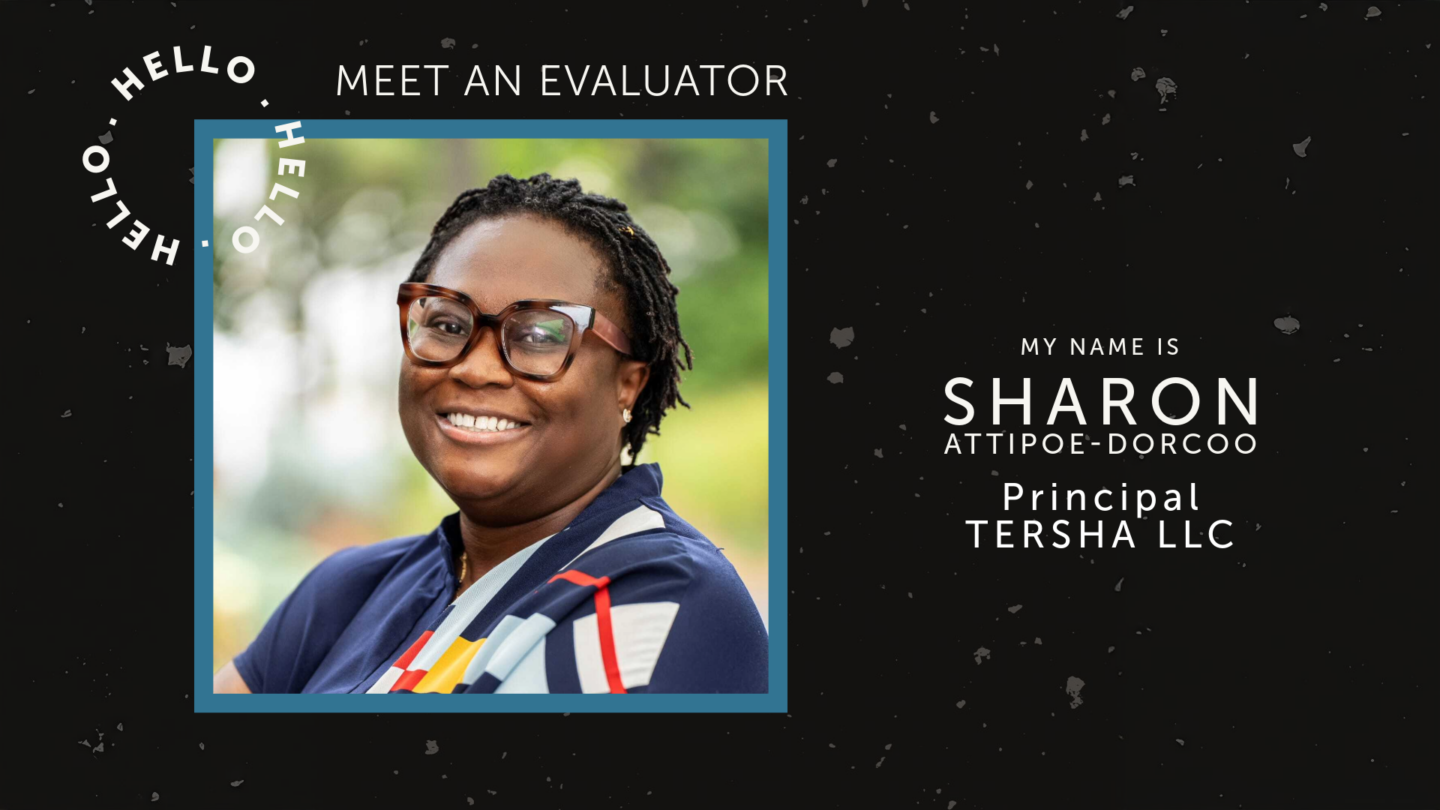
Sharon Attipoe-Dorcoo
Principal, TERSHA LLCSharon Attipoe-Dorcoo, PhD, MPH, principal of TERSHA LLC, is first and foremost grounded in her cultural identity as a Ghanaian-American and embraces her intersectional facets of being a wife and mom in her work. She is an author of a children’s book, designer, poet, award-winning consultant, and inaugural member of the Global South Arts and Health Envoy. Dr. Attipoe-Dorcoo is a member of the Advancing Culturally Responsive and Equitable Evaluation Network and a 2022 Public Voices fellow of AcademyHealth in partnership with TheOpEdProject. She is also an adjunct professor at Texas Women’s University with two decades of experience engaging in several projects focused on co-designing culturally responsive and equitable tools for research and evaluation initiatives with communities. As a speaker and facilitator, Dr. Attipoe-Dorcoo also has presented at conferences and published articles and book chapters, chairs and serves as an advisor for many entities, and has facilitated several trainings. She is a polyglot, visionary, strategist, builder, leader, and weaver who disrupts dominant narratives by encouraging thought leadership that centers the margins and embraces authentic purpose-driven being.

Except where noted, all content on this website is licensed under a Creative Commons Attribution-NonCommercial-ShareAlike 4.0 International License.



 EvaluATE is supported by the National Science Foundation under grant number 2332143. Any opinions, findings, and conclusions or recommendations expressed on this site are those of the authors and do not necessarily reflect the views of the National Science Foundation.