

Q: What evaluation approaches inform your practice? Do you gravitate more toward quantitative, qualitative, or mixed methods?
My evaluation practice is informed by a blend of approaches—all grounded in equity, practicality, and adaptability. Equally important are the frameworks that shape how I show up in the work. These frameworks, including culturally responsive and equity-driven perspectives, remind me to center lived experiences, validate multiple ways of knowing, interrogate mainstream narratives, and ensure my evaluations not only measure outcomes but honor the voices of those most impacted by the work. This grounding naturally draws me toward mixed-methods evaluation¾allowing me to tell a fuller, more nuanced story that respects both the metrics and the meaning behind them.
Q: Tell us about a particularly fulfilling evaluation project you’ve been involved in. What makes it stand out to you?
One of the most fulfilling evaluation projects I’ve led was a five-year collective impact evaluation. What stands out wasn’t just its complexity, but the transformation I witnessed among the steering committee—one of the most diverse groups I’ve worked with in terms of institution type, geography, academic rank, discipline, race, gender, and ability. This group embodied inclusion. It was the first time I had the privilege of working alongside a hearing-impaired member. It deepened my commitment to centering communication and voice in evaluation work. This project changed me. I left with a deeper understanding of what true inclusion looks and feels like in practice¾beyond race, ethnicity, and gender. I’m extremely grateful to have been part of it.
Q: How do you build trust with projects you’re evaluating?
For me, trust begins with centering the voices of the principal investigators and their leadership teams. I focus on creating a space where we can explore our commonalities, establish shared working norms, and engage in open, honest dialogue from day one. I show up as my full self—no pretense, no apologies—and that authenticity sets the tone for our collaboration. When people feel seen, heard, and respected, real partnership can flourish. Trust isn’t just a byproduct of the work—it’s something I intentionally nurture through transparency, consistency, and genuine curiosity about a team’s goals and experiences.
Q: What’s your favorite pastime or hobby?
My favorite pastime is a blend of listening to music, especially jazz and R&B, and journaling. There’s something grounding about letting music (especially on vinyl) fill the room while I put pen to paper. Music helps me slow down, reflect, and reconnect with myself, and journaling gives those reflections a place to land. And because I love coffee, this pastime isn’t complete without a great cup—whether at home or in a cozy café. This simple pleasure centers my well-being, affirms my experiences, and fosters a deep connection to my sense of purpose through a space that is both restorative and rejuvenating.
Q: What’s something quirky or unique about you that people may not know?
What’s unique—and maybe a little quirky—about me is that I genuinely see evaluation as fun. I think of it as an opportunity to bring all my toys to the playdate. To me, evaluation is both a science and an art. It taps into my logical, analytical side (organic chemistry mechanisms) and my creative, strategic side (project management and evidence-based coaching). I love watching people grow, and evaluation gives me a front-row seat to the evolving beliefs, insights, and confidence of leadership teams and participants. It’s more than data—it’s about telling stories, celebrating progress, and creating space for meaningful transformation.

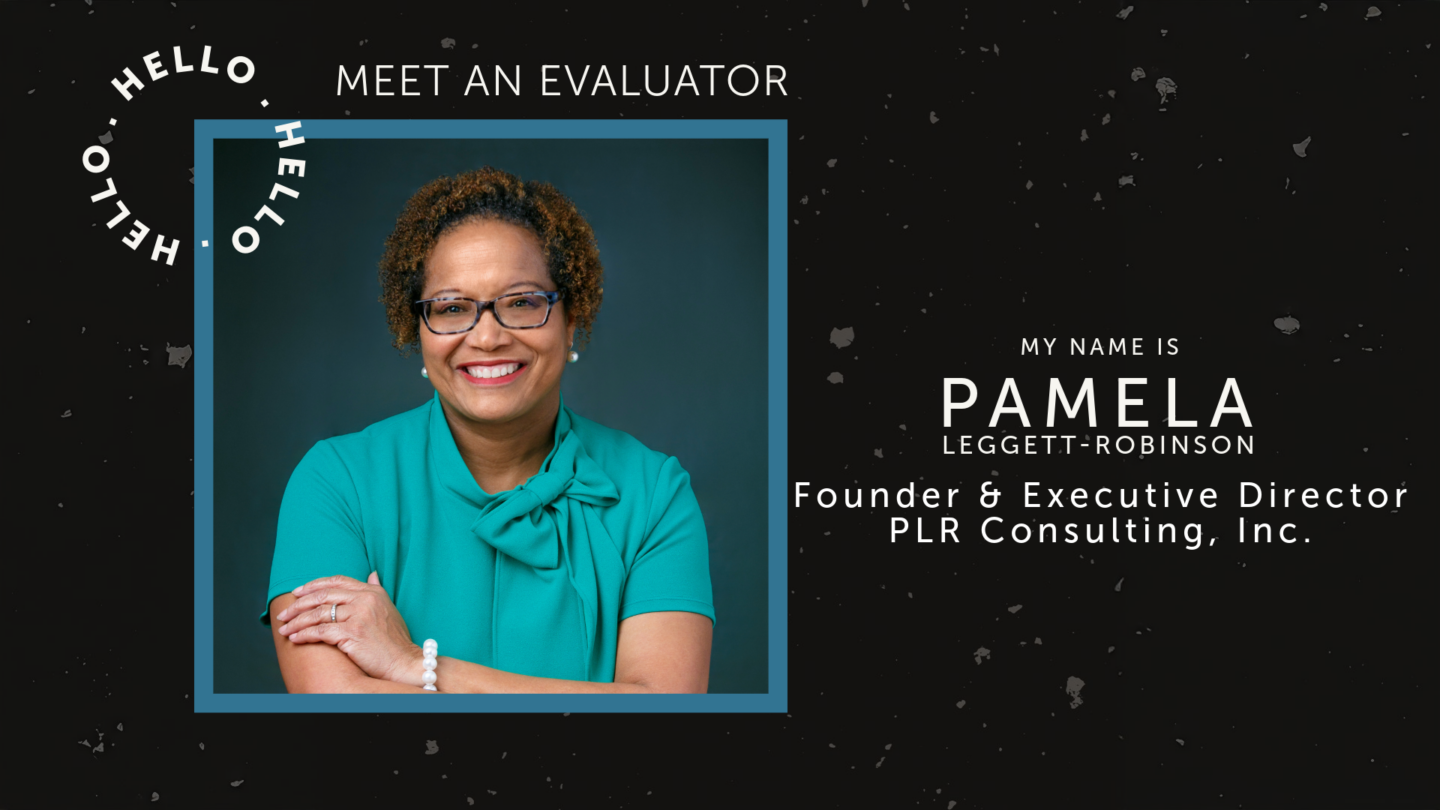
Pamela Leggett-Robinson, PhD, CAPM
Founder & Executive Director, PLR Consulting, Inc.Pamela M. Leggett-Robinson, Ph.D., CAPM, ICF ACC, is the Founder and Executive Director of PLR Consulting, Inc., a boutique consulting firm based in Atlanta, GA. With 20+ years of experience as a STEM education leader, program evaluator, and chemistry scholar, she brings a distinguished record of driving high-impact initiatives that strengthen institutional effectiveness and advance the STEM workforce. Dr. Leggett-Robinson partners with organizations, educational institutions, and individuals through program evaluation, evidence-based coaching, and project management to identify participation gaps, translate data into actionable insights, and build evidence-based solutions that produce measurable organizational impact. Her evaluation practice spans multiple NSF-funded portfolios, including ATE, IUSE, S-STEM, RCN, and Alliance projects, and is grounded in mixed-methods approaches that illuminate both program outcomes and broader project significance. She is known for bringing practicality and adaptability to complex evaluation contexts, building genuine partnerships with clients and project teams that make the work feel less like oversight and more like shared problem-solving. Dr. Leggett-Robinson holds a Ph.D. in Physical Organic Chemistry from Georgia State University, a GSEC Certificate in Evidence-Based Coaching, and holds credentials as an ICF Associate Certified Coach (ACC) and Certified Associate in Project Management (CAPM).

Except where noted, all content on this website is licensed under a Creative Commons Attribution-NonCommercial-ShareAlike 4.0 International License.



 EvaluATE is supported by the National Science Foundation under grant number 2332143. Any opinions, findings, and conclusions or recommendations expressed on this site are those of the authors and do not necessarily reflect the views of the National Science Foundation.